


“Wine is a bit like home audio” remarked a friend as we salivated over a crisp Riesling one evening. “Once you get used to the high-end stuff, it’s hard to go back.”
As someone who worked as a sound engineer many moons ago, that comparison resonates in Dolby Surround. In both cases, the moments when you have to suffer far outnumber those when everything is optimal. No, I don’t expect sympathy.
Wine’s danger zones include long-haul flights, gallery openings, ethnic restaurants and other miscellaneous cultural events. All situations that could be improved by a glass of the good stuff – and all situations where it will most likely remain a distant dream. The seasoned wine professional knows when they are beat and will swiftly order a beer. But if the pleasures of the grain aren’t for you, is there a way to make things more bearable?
I’ve learned the hard way that when it comes to crap wine, white is generally more tolerable than red. Opt for the latter in an establishment that doesn’t understand service and there’s a whole obstacle course to surmount. To begin with, reds are far more likely to be oxidised if the bottle was opened the previous day. And oak chips are near-guaranteed to put in an appearance, while the now-fatuous term ‘room temperature’ will be deployed to describe a liquid so warm, most of the alcohol has already evaporated.
Don’t fear the spritzer
Then there’s my favourite hack: a pedestrian white can easily be pimped into something far more palatable. All you need is sparkling water. To those who scorn the white wine spritzer, don’t knock it until you’ve tried it. Done right, it’s a beautiful thing: refreshing, fizzy, low in alcohol. What is poorly understood outside Austria – the drink’s spiritual home – is that a good spritzer is not forgiving of the wrong base materials. You need wine with zero oak or maturation notes, decent acidity and at least some suggestion of fruit. Complexity, ripeness and anything even vaguely tertiary are not required. In other words, the type of white on offer in less discerning environments will be perfect.
The spritzer’s other great advantage is discretion. Mix it surreptitiously in your water glass – the classic proportions are about 40% wine, 60% water – and no one need ever know you couldn’t force the wine down unadulterated. Good luck trying that with a Kalimotxo – theoretically also an option should the house red be undrinkable.
If you find yourself on licensed premises, ground rule number one is to identify the nature of the establishment. Your guard should already be up when there are no vintages specified on the wine list. When the ‘list’ is merely a loose suggestion of region and grape variety, run and hide. You’re going to need the sparkling water. Don’t even think about ordering something more expensive from a well-known appellation. That ‘Sancerre’ or ‘Chablis’ will merely be an exercise in resentment, an illustration of how badly France’s appellation system is fucked.
House wine in these situations is frequently the lesser evil. Since it’s what most people will be drinking, the restaurant/bar/supplier probably spent more time and care selecting it than the supposedly premium options – which no one will or should order.
Mile high wine
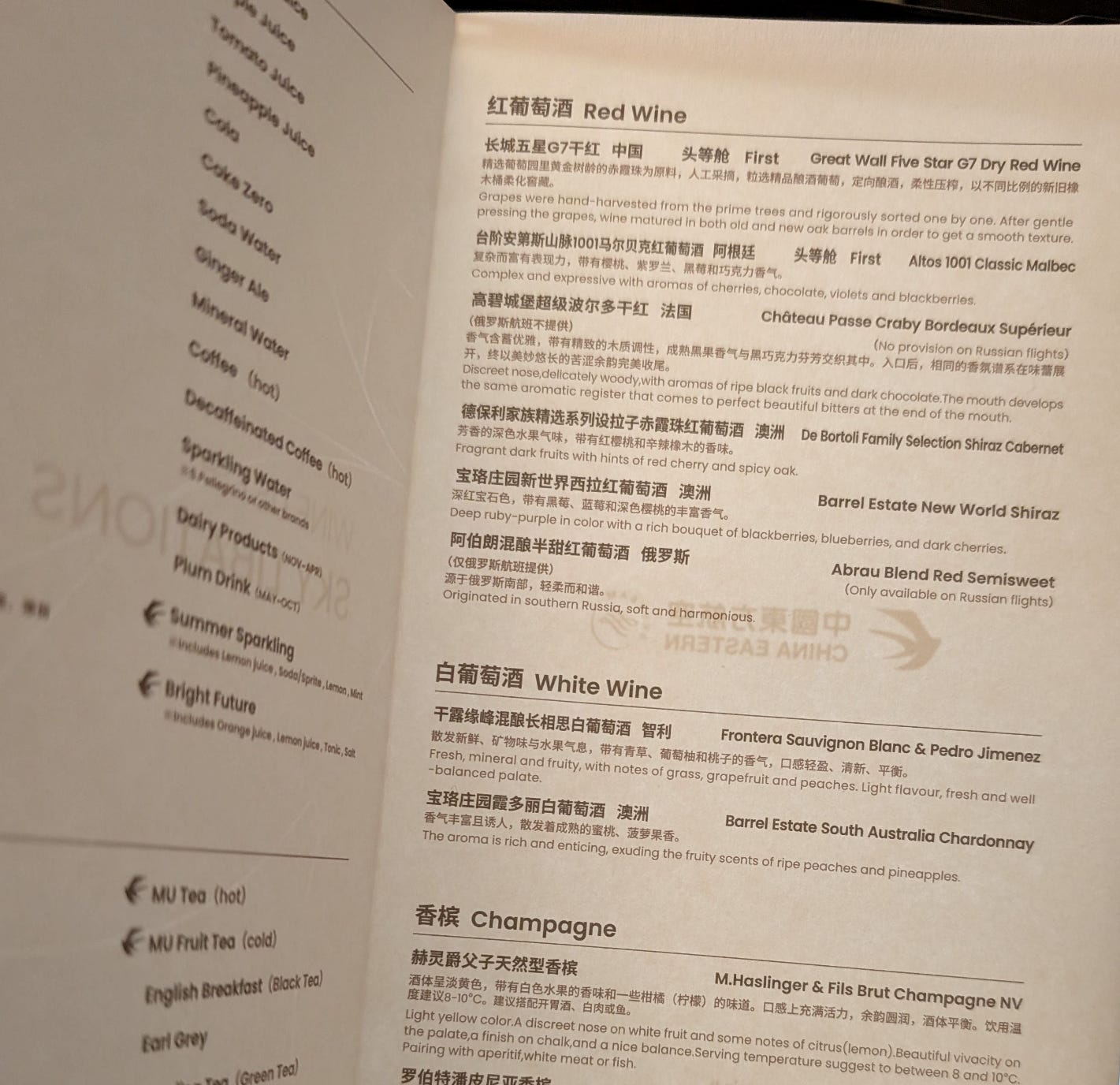
That leaves the faux-luxury situation that is long-haul business class. I am hardly a regular, but a generous client flew me business to Shanghai on China Eastern last year. The spacious lie-flat seating, linen tablecloths and silver laminated chopsticks all boded well, but the wine list wouldn’t have been out of place in a Wetherspoons pub. There was one ray of hope: nestled among barrel-fermented this and Shiraz–Merlot that was a Bordeaux Supérieur from a vaguely recognisable name: Château Passe Craby.
I pointed at the card when the flight attendant came by – the alcohol is coyly kept off the trolley and there were no bottles to eyeball. She adopted a facial expression somewhere between fear and incomprehension. “I will go check,” she said, with about as much confidence as a Labour MP in Clacton. Ten minutes later she reappeared with a glass of something unidentified and red. I took a sniff. It smelt reassuringly Bordeaux-like: blackcurrant, a hint of lead pencil. It delivered everything a young claret should: fresh, salivating acidity, taut fruit, firm structure.
I was amused by its presumption, so I asked for another glass. When it came, the wine was clearly different, smelling and tasting like stewed Shiraz. Amid some concerns about the flight attendant’s head exploding, I demurely indicated that it wasn’t what I’d ordered. Would she mind terribly seeing if she could find a glass of the previous option? More finger-jabbing at the printed menu. I’d love to have been a Mandarin-speaking fly on the wall in the galley at that point. To give the crew their credit, the correct bottle was located and the eccentric Englishman was most satisfied.
I feel obliged to point out, lest anyone be disappointed, that China Eastern does not serve the Passe Craby on flights to or from Russia. No, me neither.
Sadly, good wine on planes has become rarer than a space in the overhead lockers1. Air Dolomiti and TAP both used to pour a selection of decent regional wines by the glass – even in economy. Those days are long gone. But if there is a moral to my story, it’s just to keep your eyes peeled. Occasionally you get lucky.
My squash partner has been goading me for weeks about ordering the Sancerre at our local club in Amsterdam. The bar is typically Dutch – a small selection of draught beers, all from the Heineken stable, the usual spirits and mixers. It is resolutely unfancy and I’ve never seen anyone order wine. According to my research, said Sancerre turns out to be from a very decent biodynamic producer, wild fermented and racked by the phases of the moon. The vintage is given on the list and the price is absurdly cheap.
We haven’t dared try a bottle yet. Maybe it’s time.
Originally published in Noble Rot issue 40, March 2026
My original text had “rarer than a child without an ADHD diagnosis”. This was considered to be too tasteless and the editor took it out.
Great article. You didn't mention that one can always cook with it. Despite the snobby view that one should only cook with the wine that will be served, I've found for anything slow cooked, cheap wine usually works fine. Mybe not to tart up the noodles on your China Eastern flight though