

Slovenian Winemakers Face Threat of Not Being Allowed to Sell Wine
Here's the full details, plus how you can help
When I first wrote about Slovenia’s new wine law back in April, it was a confused picture. Some commentators claimed there was “nothing to see here” whilst others insisted it spelled disaster. The situation remains as hazy as an undisgorged pét-nat.
Here’s the key change: the new law requires all wines to be approved by a tasting panel, even those that are declassified and labelled without geographical indication.
Sandra and Matej Bizjak, aka Santei wines, have tried to get clarity. The Vipava-based biodynamic winery engaged a lawyer to contact the Slovenian Department of Agriculture. They wanted to be sure they had understood the changes.
The outcome is worrying. It looks like Slovenian wine law is coming for natural wine.
Santei just launched a petition to gather support and put pressure on the government to amend the law. If you already know enough, please go ahead and sign it.
Read on for more background and detail about what this means.
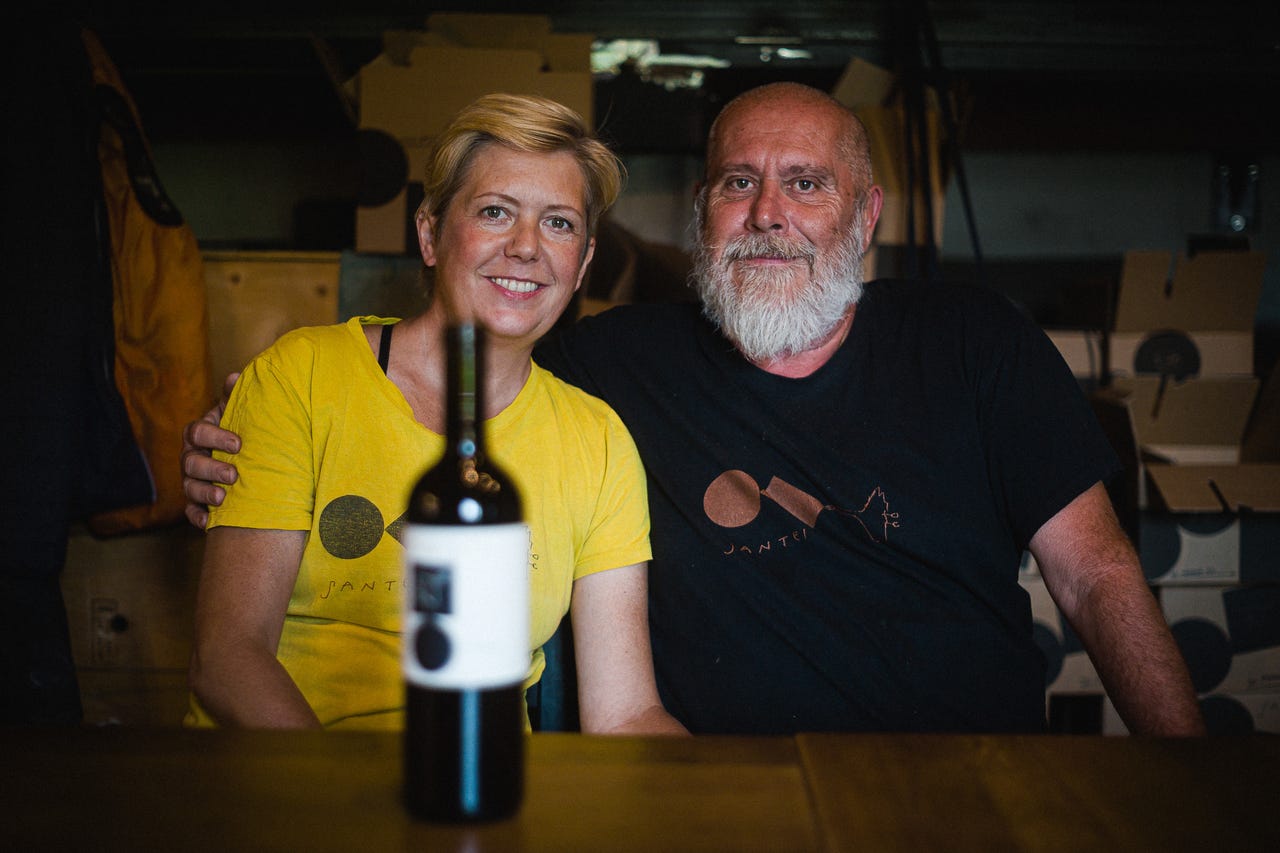
Matej only discovered the law had changed when he brought newly bottled wines to the KGZS1 laboratory in Nova Gorica in March 2026. The couple label their wines without geographical indication (GI) so that - under the terms of the existing law - they only require approval via lab analysis. This follows previous experience of their wines being rejected by tasting panels when they labelled with the region of production.
But now, Matej was told, even non-geographically labelled AKA table wine2 must pass an organoleptic test. The KGZS employee sniffed one of the wines and told him it wouldn’t pass. He returned home without submitting the bottles.
The Bizjaks then took their wines to the KGZS centre in Novo Mesto, a city two hours drive away. Novo Mesto had not yet updated their procedure, so the wines were approved on the basis of only the lab analysis.
Submitting wines to a different location is common practice amongst low-intervention growers, as some KGZS centres - for example Ljubljana - are known to be more lenient than others3.
The Novo Mesto lab has since adopted the new law, ruling out this option in the future. The situation could differ in each lab, as the new law has a two year grace period during which it must be implemented.
Tamara Lukman and Janko Štekar produce natural wine in Goriška Brda. They have navigated a tortured path around Slovenia’s wine laws for the last 20 years. Lukman told me that “probably we will just stop selling the wines in Slovenia at all, as it is we only sell about 5% in Slovenia.” Her analysis of the new law is that it does not restrict a producer’s ability to export, even if the wines were rejected for domestic sales.
She explained that every Slovenian grower who owns more than a hectare of vineyards is obliged to pay a membership fee to the Chamber of Agriculture and Forestry (KGZ). “They are supposed to be working for our benefit,” she said, “but it doesn’t feel like it.”
A case against natural wine?
The Bizjaks’ lawyer reported back to them in mid-April. Sandra translated the response for me:
The new ZVin-1 in Article 24 does indeed stipulate slightly stricter conditions for the marketing of wines without a geographical indication, as the law also requires these wines to undergo an analytical test and an organoleptic assessment, whereby the five parameters set out in Article 20 of the Commission Implementing Regulation (EU) 2019/34 will be assessed, but a wine without a geographical indication will only receive a rating of suitable or unsuitable for the market (as opposed to GI wines, which will be scored), as explained to us at the Directorate of Agriculture of the Ministry of Agriculture, Forestry and Food.
The Directorate explained to us that such an arrangement is a compromise reached by the working group for the drafting of the law, in which representatives of winemakers also participated. According to their explanation, this would not limit the competitiveness of Slovenian producers, but quite the opposite, as wines without a geographical indication will thus be “more qualified” compared to the previous regulation. Since wines without a geographical indication are subject to more lenient test rules (only determining whether a wine is suitable or unsuitable for the market), this should not worsen the situation of Slovenian winemakers compared to foreign winemakers.
Why this is problematic
The idea that “wines without a geographical indication” will somehow be “more qualified” might sound attractive, but in reality tasting panels often reject wines that don’t conform to a mainstream formula. Artisanal winemakers have historically chosen to label without geographical indication, to avoid this risk. But the new law removes this option.
If the tasting panel rejects a wine submitted without geographical indication, that means it cannot legally be sold - at least, not in Slovenia. Unlike the equivalent process in Austria, the winemaker may not resubmit. This could force affected winemakers out of business, unless like Štekar they are willing to abandon the domestic market.
As Lukman and others pointed out, it also puts Slovenian winemakers at a competitive disadvantage, because imported wines are not subject to the same restrictions imposed on domestic producers.
Who wanted this change?
Many have asked why the change in Slovenian wine law was introduced, and who was consulted. The Ministry of Agriculture worked closely with the Association of Slovenian Winemakers, and the Association of Family Winemakers (ZDVVS), a private organisation whose current president is Aleks Simčič (from the winery Edi Simčič). The Association of Slovenian Winemakers represents the country’s cooperative cellars plus other large companies active in the supermarket wine sector.
It seems that both these organisations would be happy to see the natural wine sector die. Jure Grubar, a member of the Association of Slovenian Winemakers, has already voiced his dissent to Santei’s petition here.
You might assume that the new law will only hurt a few radical winemakers who flirt with high volatile acid levels or bottle without the use of sulphites. But my recent conversations suggest that a much wider range of growers could be affected.
Those who have expressed concern to me so far include Blažič, Keltis, Aleks Klinec, Dejan Kukanja and Kmetija Štekar. Dozens more could find themselves in the firing line. All winemakers who adopt artisanal practices such as fermenting with indigenous yeasts, bottling unfiltered and minimising sulphite levels are at risk, because their wines don’t fit the cookie-cutter mould.
Please sign the petition
If, like me, you feel this new law is harmful to Slovenia’s artisanal wine growers, please sign Santei’s petition and share this article as widely as you can.
KGZS = Chamber of Agriculture and Forestry of Slovenia. The organisation sits in-between the Department of Agriculture and the farmers themselves.
The Slovenian table wine category namizno vino doesn’t officially exist any more. Instead, producers must write just “Wine from Slovenia” on the label, along with a generic name such as “white” or “red”. Grape variety, year and geographic information may not be mentioned.
The situation has been similar in Austria for some time, with Eisenstadt famously the most lenient. However, DAC rules now prohibit producers from submitting their wines outside the region of production.