

Austria's Wine Law is Bankrupt
A 100 point red wine from Burgenland sets the cat among the pigeons: “Austria is making itself a laughing-stock”
Visitors to VieVinum - Austria’s most prestigious wine fair, held last weekend in Vienna - were expecting three days of deliciousness and conviviality. The sight of two grown men shouting at each other during a press conference was not supposed to be on the agenda.
The public spat erupted during a discussion panel entitled “Tu Felix Austria - Where do you go to my lovely?”, when famed Mittelburgenland winemaker Roland Velich responded to a direct accusation from Rudolf Schmid (head of the wine department at the Austrian Ministry of Agriculture) that he had orchestrated a PR stunt.
Velich had good reason to be angry. The 2023 vintage of his super-premium Lutzmannsburg Alte Reben Blaufränkisch was hailed as a masterpiece by critics late last year. But in early 2026, the wine was rejected by the official tasting panel as faulty, on numerous different counts. It must now be relabelled and sold as a table wine (Wein aus Österreich), without mention of the region or the vineyard.
Perfect or faulty?
Lutzmannsburg Alte Reben 2023 first made the headlines in late September 2025, shortly after wine critic Stuart Pigott - at that time employed by JamesSuckling.com - tasted and rated the wine with a perfect 100 points. Others also praised the wine. Falstaff’s Peter Moser scored it 99 points in November 2025.
Velich’s Blaufränkisch has consistently wowed the critics since he began making it in Lutzmannsburg in 2001. The latest vintage looked set to cement his reputation as one of the region’s foremost exponents.
Schmid appeared to be oblivious to the timeline - his accusation that Velich had “arranged” the score purely for marketing purposes made no sense. Velich bottled the wine on 4th September 2025, and made it available for critics to taste shortly after. He had every expectation that it would receive its prüfnummer - its passport to be labelled a quality wine from Mittelburgenland - as it had for the previous two decades. He submitted the wine to the tasting panel twice, first on 26th November 2025 and then again at the end of January 2026. It was rejected both times.
There is little doubt that the system is broken. The only question is what comes next.
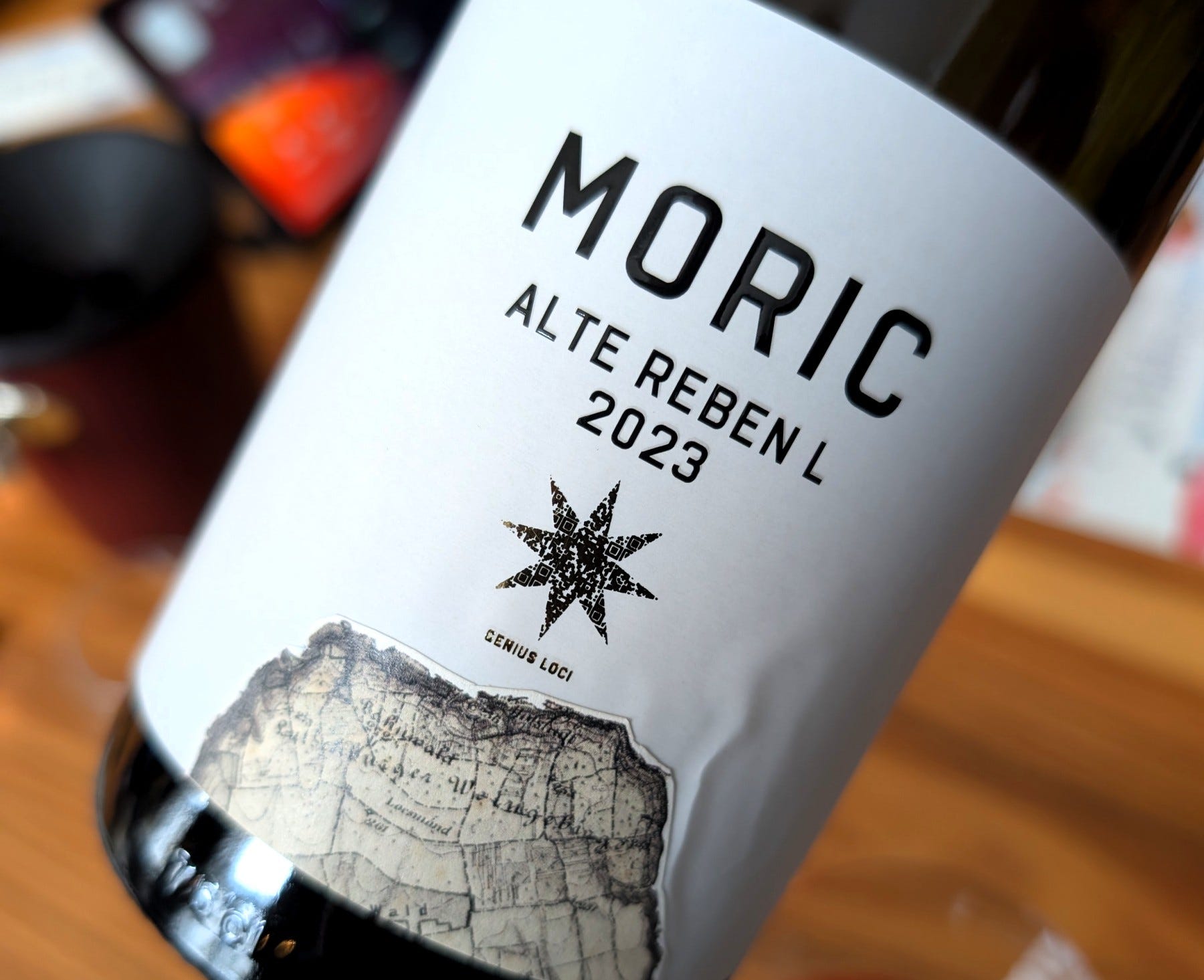
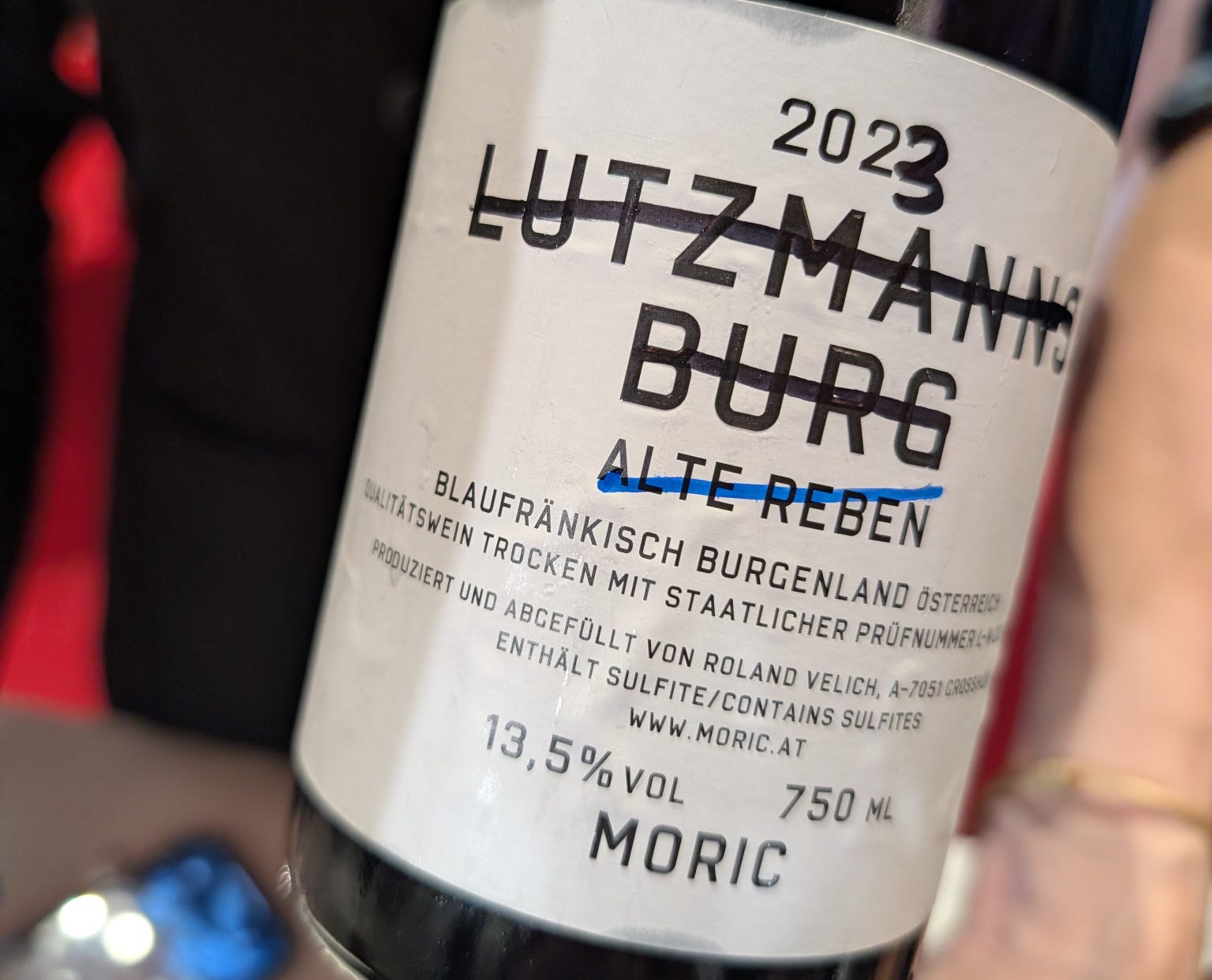
Velich delayed the wine’s release while a new label was designed. It is now renamed Alte Reben L 2023 (see photo above), with all the geographical terms removed. Velich is no fool, and clearly chose his moment - just before VieVinum - to go public with what he perceives as a scandal.

Having engaged a crisis PR firm, Velich sent a press release to journalists on May 7th. Titled “Austria is making itself a laughing stock as a wine country”, it recounted the whole affair and invited recipients to a press conference in Vienna on May 12th - which I attended.
In the press release, Velich compares the situation to Domaine de la Romanée-Conti being bottled as Vin de France. Let no-one say he is a shrinking violet.
Courting the press
At the press conference, Velich recapped his story, and summarised how the Austria wine regulatory system functions. In particular, he outlined how growers who work with minimal intervention - spontaneous fermentation, no additives or corrections, no filtering or clarification - are regularly penalised for making wines that are supposedly “not typical”.
Also at the press conference was State Secretary Sepp Schellhorn. He talked about the much heralded new wine law (Das Neue Weingesetz). Austria’s wine regulations have not seen a major overhaul since the aftermath of the 1985 wine scandal. The rise of the natural wine sector in particular has caused considerable challenges.
As I wrote in 2024, countless low-intervention winemakers have abandoned the quality wine system, instead declassifying their entire output to table wine, and accepting that they cannot mention geographic terms on the label. Growers usually make this choice after their wines are repeatedly refused the prüfnummer. The usual reasons given by tasting panels are that the wines are cloudy or hazy, they are not typical of the stated variety or region, or that they display a fault such as volatile acidity.
Schellhorn painted a positive picture of the new wine law, for which a first draft is expected in July this year. He agreed that Velich’s situation was ridiculous. His comments were measured and diplomatic, without giving too much detail.
Conspiracy theory
From this polite start, the situation spiralled. Following the explosive VieVinum session, an article appeared in the Austrian wine magazine Vinaria claiming that Velich’s wine had attained the prüfnummer and that he had simply fabricated the whole story as a marketing stunt. The article quotes Johannes Schmuckenschlager, the president of the Austrian winemaker’s association. He attacks not only Velich but also Schellhorn. “Hands off our wine law” he is quoted as saying - “We don’t need a new one.”
The Vinaria article is poorly researched. The writer doesn’t appear to realise that James Suckling did not personally review Velich’s wine. A pixellated image of Velich’s draft label is provided as the only proof of the article’s thesis.
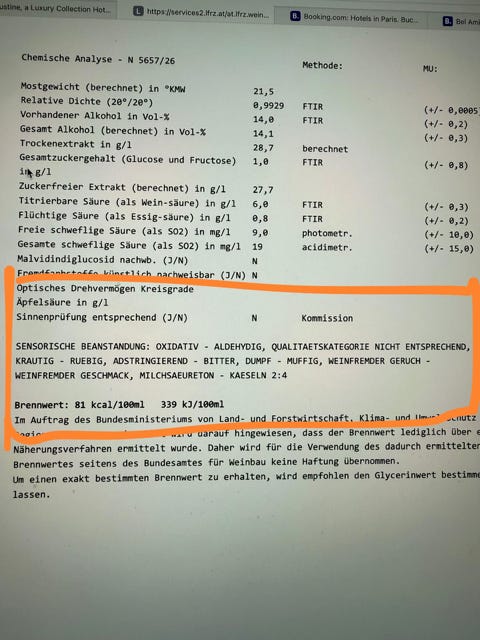
Velich personally showed me the report he received when he submitted Lutzmannsburg Alte Reben 2023 to the tasting commission. The reasons for the wine’s rejection include ‘not typical of the region’, ‘not typical for quality wine’, and that it is ‘dusty’ or mouldy (muffig in German), oxidised and bitter.
I tasted the wine on three separate occasions last week. It is a thrilling Blaufränkisch, showing typical Mittelburgenland power and concentration. Velich’s preference for long ageing in neutral, large-format oak lends the wine complexity and depth. I would not describe it as dusty or oxidised, but it is also not a simple, fruit-driven style.
The nose has an enthralling perfume of dark cherries, woodsmoke and herbs. It’s structured, long and complex, with chunky tannins. Regular readers will know that I don’t believe in points, but I support the view of my colleagues that this is an exceptional wine.
Following the Vinaria article, Stuart Pigott - the critic who rated the wine with 100 points - posted a bizarre reel on Instagram where he insists he is not part of a conspiracy. Even more bizarrely, he threatens persons unknown that if the talk of said conspiracy over Velich’s wine does not end, he will be forced to take some kind of unspecified action.
Will the new wine law solve anything?
All eyes are currently on Das Neue Weingesetz to provide a solution for the countless winemakers whose work is rejected year after year by the tasting commissions. But from what I’ve been told, the situation does not look hopeful.
During the VieVinum session, Schmid outlined one of the supposed innovations in the coming law. He said that each region’s winemakers will be asked to decide amongst themselves how appellation and single vineyard wines should taste. Winemakers must agree on a ‘standard’ that can be used as a reference point when wines are submitted to the tasting panels for approval.
This sounds nonsensical. It risks that the largest or most vocal wineries force a formulaic definition onto everyone else. As Willi Klinger (ex director of Austrian Wine Marketing) and others asserted at the session, diversity must be recognised when it comes to single vineyard expressions. It is impossible for any one taster or winery to define how each site should taste.
The other big change would allow a winery to opt for a ‘low intervention/natural wine’ category, and then be granted more latitude by the tasting panel. This would theoretically allow low intervention/unfiltered/natural wines to display appellation and vineyard names.
But each winemaking region has been asked to vote on whether they want to allow this construct or not. So far, most regions have reportedly voted against it. When I asked Velich about the idea, he said “I don’t want to put my wine in a special category, I just want it to be accepted as wine.”
Whilst we wait for July, Velich is finally set to release his Alte Reben L 2023. Meanwhile, hundreds of Austria’s top winemakers continue to fight with the tasting commissions, endlessly resubmitting wines or opting out of the system entirely. Unless you produce a formulaic, interventionist style, there is no guarantee that your wine will be approved.
Velich has never allied himself with the natural wine sector, although he is now dealing with the same issues that low intervention icons such as Claus Preisinger, Franz Weninger or Ploder-Rosenberg have suffered for years. Some commentators have poured scorn on Velich’s blaze of publicity, reasserting that it is nothing more than marketing. But others are happy that the issue has been brought into the public eye, and that the absolute bankruptcy of the tasting panel construct has been highlighted.
There is little doubt that the system is broken. The only question is what comes next.
Simon, Laws, laws, and damn the statistics! I find it interesting that in the analyses you showcase, pH is not there, which seems surprising to me. All the other numbers 'look fine'. So, I am not a fan, from a critical or winemaking POV, of VA, brett, oxidation etc, unless the wine is purposely made in a manner that is oxidative like sherry or madeira etc. Mousiness? Definitely not acceptable, but that does not seem to be the criticism here. So, it sounds more like the Board objects to its appearance, and made up the rest? Cloudiness could be a legitimate problem if other things were here, too, such as MLF in bottle (not likely in a red wine). I cannot believe that our friend Stuart P would not pick up on VA, Oxidation etc if in fact those issues were present. Brett? Well, one forgives a little bit if the wine is of a certain style, and Blaufr. can be one of those, so long as it hasn't taken over. The numbers certainly otherwise suggest a sound wine (pH would be a critical factor here from a detective's point of view!) If the wine were as faulty as the critique by the Board suggests, I am sure that Mr Velich, whom I met years ago in Austria, would be honest enough to not release the wine, or attempt to address the issues. Kinda crazy situation. I understand the desire of the AUstrian wine board to not allow clearly defective wines to gain an Appellation status, but I also abhor the notion of enforcing rules/concepts that only want to permit a çookie-cutter'approach to winemaking. Clearly, something is wrong with the system which seems so rigid that it cannot distinguish between interesting wine vs truly defective wine. Joel Butler MW
I've been sitting on the sidelines, like many small Austrian producers, patiently waiting for the big names to address this issue and it looks like the time has come.