

Growing Grapes Under Glass
Could this be the future of vineyards?

If you fly over the Netherlands, you’ll see areas dominated by seas of plastic-roofed greenhouses. Industrial fruit and vegetable farming has long since adapted to the convenience and consistency of growing everything indoors.
Could this be the future for grape growing too? A research project developed by Geisenheim University has brought that possibility closer than ever before.
Thanks to my colleague and friend David Schildknecht who shared this article with me. He noted that “it raises some interesting questions about what intervention one would consider consistent with natural wine.”
That’s putting it mildly. Never mind the questions, I wondered about my answer. It wasn’t obvious, hence this long-form attempt.
For those of you feeling time-poor, here’s an executive summary of the article:
Geisenheim university, Germany’s most famous wine school, is running an experimental project in the Rheingau where solar (PV) panels are mounted on poles high above vineyards.
The generated energy is used to provide passive protection against heavy rainfall, frost and drought, with heating wires and drip irrigation lines installed along the vineyard rows. It’s almost like growing vines in a greenhouse, as the panels protect from and diffuse the sunlight equally over the vines.
The technology is called VitiVoltaic, and two vintages have already been vinified from the test site.
If you’re a minimal intervention-minded grower, or a natural wine fan, you might recoil in horror at this seeming attempt to play God. But I wanted to take a step back before my knee-jerk reaction kicked in.
Where is the line in the sand when it comes to intervention in the vineyard? When are growers protecting their most important asset and being good stewards of the soil? And when are they simply giving in to market forces instead of prioritising nature and nurture?
VitiVoltaic has many potential advantages. It can tackle labour shortages and make difficult to work sites (such as steep slopes) more economically viable. A grower near Stuttgart wants to install the technology on a vertiginous plot, harnessing the generated energy to power a drone tractor that automates the vineyard work.
Vines that are protected from extreme weather events such as unseasonal frosts or floods could avoid or at least mitigate the appalling crop losses that many European growers have to bear in some years.
Couldn’t that make small wineries more sustainable as businesses?
For and against

I asked seminal low-intervention winemaker and president of Vinnatur Angiolino Maule, what he thought about VitiVoltaic - Maule generally welcomes science and innovation in the context of natural winemaking. His right-hand, director of VinNatur Emma Bentley also weighed in.
Both were sceptical about how healthy it could be for vines to be shielded from the sun. Maule said “If there isn’t direct sunlight the plants don’t work. And if they don’t work, they can’t capture atmospheric nitrogen and CO2. You wouldn’t get good ripening and that’s not my opinion - it’s agronomy.”
The university has already produced two vintages from their experimental VitiVoltaic-protected plot, which they say are lighter and fresher - “just like it used to be.” Bentley suggests that “lighter and fresher” might simply mean the fruit wasn’t fully ripe.
She also questioned whether the hefty upfront investment could ever be recouped - in theory excess generated energy could be sold back to the grid, but most likely at a very low price.
Minimal intervention growers are sometimes accused of being luddite, spurning modern advances in favour of more primitive practices. Are VitiVoltaic and similar technologies likely be rejected out of hand by the natural wine community? Not necessarily.
Welcome to the machine
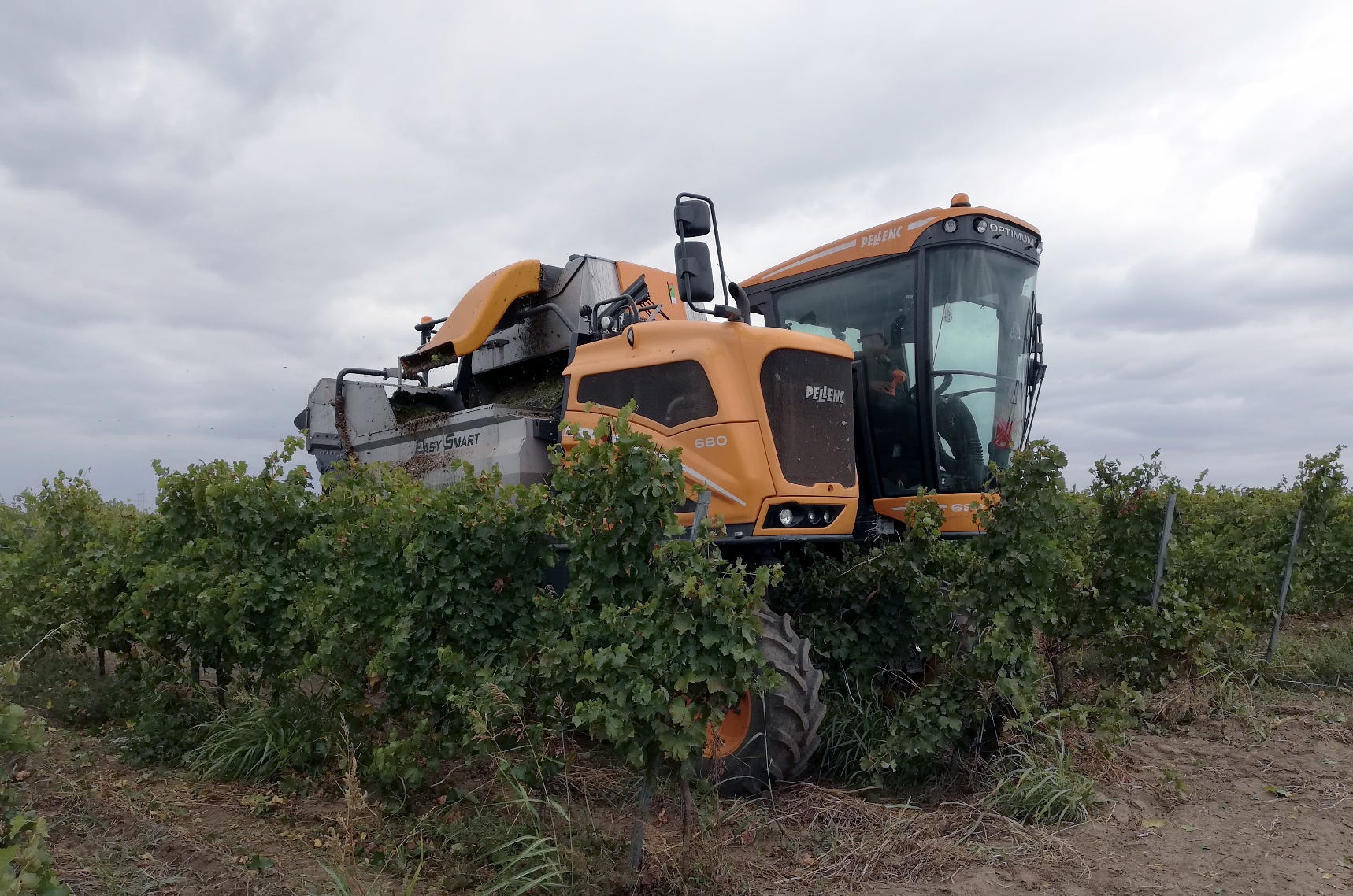
Many natural wine purists staunchly oppose machine harvesting. A spat ensued between Austrian biodynamic giant Meinklang and American natural wine writer Aaron Ayscough in 2023 when Ayscough pilloried the family online for their use of harvest machines1.
Meinklang’s Werner Michlits outlined the difficulties of finding large teams of harvest workers, and the social challenge of housing and looking after migrant families - it’s now well-nigh impossible to source physical labourers in the local area.
Michlit’s decision feels pragmatic, even if it is at odds with natural wine’s unofficial manifesto. Meinklang operates at a scale that most other natural growers do not - they farm 2,500 hectares, of which 80 are under vine. They are obsessive about looking after their land - all of which is certified biodynamic, and farmed without any chemical/synthetic inputs.
If machine harvesting allows them to stay afloat, isn’t that a sensible compromise? The environmental pollution that would result if Meinklang’s massive tract of land was sold to an intensive livestock facility or a conventional arable farm is unimaginable.
Messing with the vines
If machine harvesting is still largely seen as a no-no in natural-land, what about the use of drones or lightweight drone tractors to spray vineyard treatments? It could deliver huge benefits in terms of reducing soil compaction (less passes with heavy machinery) and the use of fossil fuels.

Zsolt Sütó is a well-known pioneer and advocate for organic farming and minimal intervention winemaking in southern Slovakia, at his Strekov 1075 estate. He’s one of many currently experimenting with drones to spray biodynamic preparations - no luddite tendencies here.
Planting modern resistant grape varieties is another solution to challenging climate conditions. Sometimes known as PIWIs, these crossings of Vitis vinifera with resistant genes from American or Asian species such as Vitis labrusca or Vitis riparia have been developed to withstand cold, damp and even drought conditions.
One could argue that the creation of such varieties - done in a lab, by making 10,000 or more crossings and then isolating a single successful progeny - is a heavily interventionist process that wouldn’t find much truck in the natural wine community.
But for growers who spurn systemic treatments against mildew and rot, PIWIs are an inviting solution to the constant need to spray copper and sulphur. Might they offer a more sustainable future?
The natural wine community has embraced PIWIs arguably to a greater degree than the mainstream wine world. Gut Oggau, Ploder Rosenberg and Kobatl in Austria are all major proponents. Thomas Niedermayr, based in Alto Adige (AKA Südtirol) is the furthest ahead, producing beautiful wines from organically farmed Bronner, Solaris and Souvignier Gris. He pulled out his last Viti vinifera vines in 2019.
Luddites or artisans?
Natural growers can clearly also innovate. Just because they refute some modern practices doesn’t mean they are tin foil hat wearing primitives. So where does that leave VitiVoltaic?
Reading about the Geisenheim experiments, I couldn’t help feeling that such a major vineyard intervention amounts to distortion of terroir. If it allows grapes to be ripened and wine to be made in a manner that would have been common a few decades ago, that surely means it’s no longer expressing current conditions.
The magic of wine is partly its ability to articulate vintage and climate differences. Growers might be tormented by ever-changing conditions, but this is also part of the fascination. Which serious wine lover wants every vintage to be identical?
Thinking back to those Dutch greenhouses, consider the hydroponically grown tomato. Perhaps they are a fair compromise for those who want to eat something tomato-like in the winter. But they will never attain the profound deliciousness of something that’s been slowly ripened in Mediterranean soil and sun.
VitiVoltaic, to me, is a step too far from artisanal farming and towards a vineyard-as-factory concept. Instead of working with nature, its goal appears to be to subdue and moderate it.
The use of solar energy to power other winery operations is clearly a positive, but that doesn’t depend on the panels being installed above the vineyard. For the moment, there are less invasive solutions for artisanal growers to tweak the vineyard environment to respond to climate challenges: ground cover (planting grass or other crops between vineyard rows), planting trees in the vineyard and reviewing pruning and canopy management are examples.
These techniques won’t prevent the more extreme ravages of nature - but neither do they mute the expression of time and place that is so key to our ongoing love story with wine.
Comments are open on this article, I’d love to hear your take on intervention in the vineyard. Where would you draw the line?
Ayscough’s article is fairly measured, but the discourse became more barbed in a series of back-and-forth posts on Instagram at the time
Maybe I'm too much of a sci-fi geek, but I instantly thought about a habitat ring in Star Trek or futuristic dome on Mars. But the future is already here. This will get done, is getting done. We have wineries in all 50 U.S. states and Montana and North Dakota do not have hospitable winters. But crops are grown. Humans find a way. We will continue to innovate.
The natty crowd has a scale issue. You reference using machines to pick grapes. This shouldn't be controversial, it's the only way to keep the price down. And part of the appeal of natural winemaking is its reasonable pricing. Labor will not be getting cheaper. Ever. The natty community will have to find a rationalization for using machines.
Speaking of rationalization, I said this on another forum, all wine is intervention, it's just a matter of degree and rationalization. I know natty winemakers and their advocates who eat tomatoes in winter, Doritos, Top Ramen, and cheap bulk pasta, and drink cheap beer, but want the highest standard for their grapes or winemaking. Rationalization. Like your PIWI reference, that's acceptable but using a machine to pick the grapes is a problem?
I don’t know enough about wine specifically, but there are so many things we don’t understand about how nature works that I’d be very suspicious of shielding plants from sunlight. Even though glasshouses have been used for centuries. And we can get decent crops from modern plastic greenhouses. I would agree that it breaks the definition of natural. Just as one small related example, many of us are growing grapes at home here in Upper Austria but we all plant them against or near a south-facing wall. What if the building materials are off-gassing whatever over the years and the strong summer sunlight against the wall is creating molecules that would never exist in nature, and these enter the grapes? Well for such small home harvests who cares. But on a massive scale, there are probably some differences. Maybe they’re harmless, maybe not.